AI spend in go-to-market has exploded over the past few years. Unfortunately, pipeline hasn’t grown much along with it.
More than half of enterprise generative AI budgets go to sales and marketing. Yet MIT researchers found that 95% of enterprise generative AI pilots have no measurable impact on P&L.
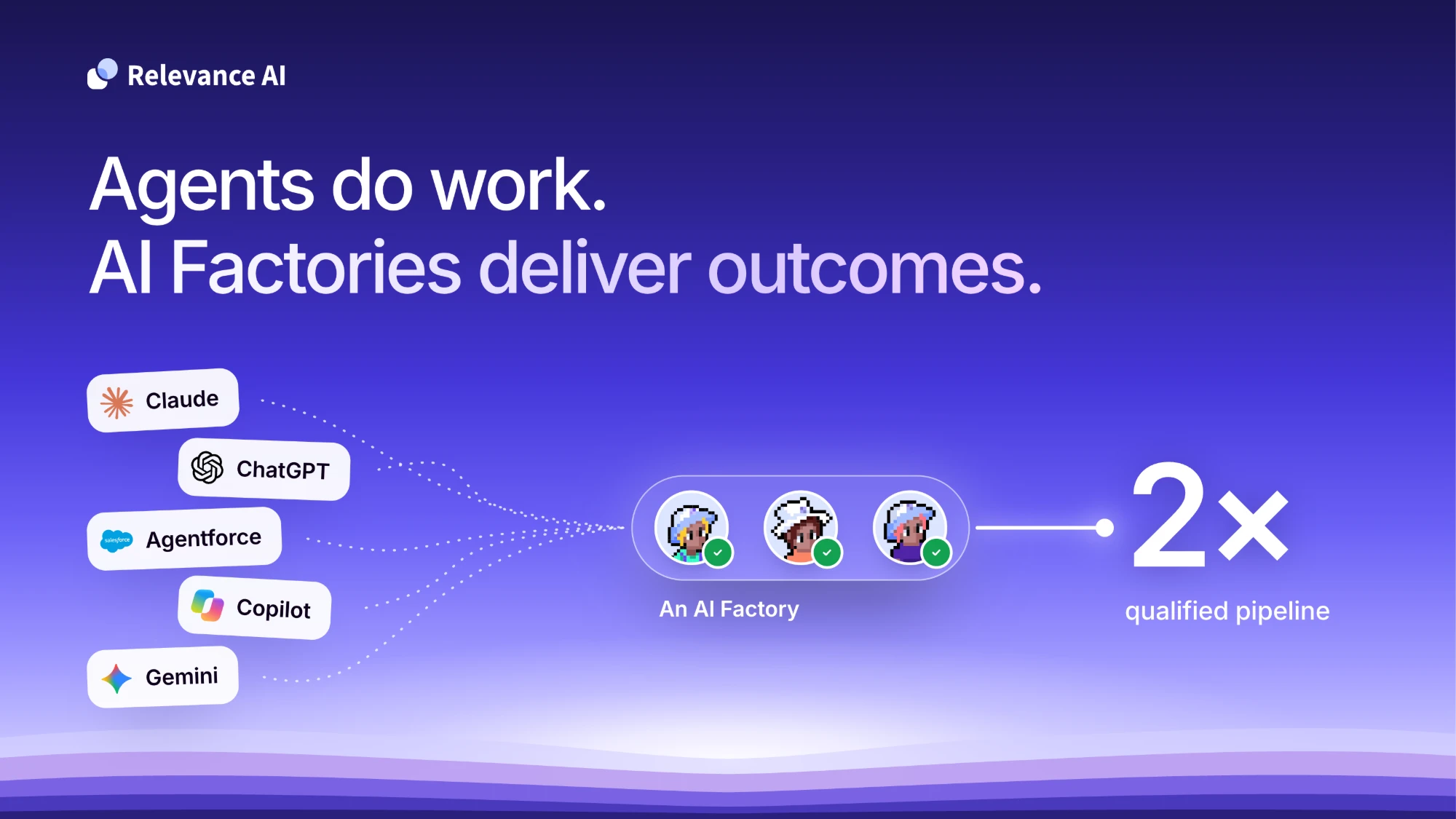
Agents do work. They can execute activities. But it’s AI Factories that deliver real business outcomes.
Today, Relevance AI announces that it is an AI Factory company.
For years, people have described Relevance AI as a no-code platform for building AI agents. Building agents is still important. But it’s no longer the greatest value that we provide to our customers. The value of Relevance comes from the power of the AI Factory.
Relevance AI helps enterprises drive outsized business results by providing a platform for building and running self-improving AI Factories. An AI Factory is a system of specialist agents and people, aimed at driving a business number. With Invent 2.0, our factory engineer, we build the factory with you. Your team defines the process and decides what good looks like.
The AI experimentation era is over
Leaders told their teams to adopt AI and automate work that was impossible to automate before. Teams now run their own assistants and copilots. Departments buy point solutions for single tasks. Someone in RevOps builds three agents over a long weekend. Some of them work. Nobody can say which ones.
Meanwhile, token bills keep climbing. Surprise invoices push companies to limit who gets AI, or which AI they get. Executive leadership wanted something else all along: a measurable change in pipeline, conversion, retention, or support response times.
Today, almost anyone can build an agent. Having an agent successfully complete meaningful work is a different story. Trusting one to run critical work at scale is harder still.
This is where many agent initiatives stall. The prototype works, and the first few runs look promising. Then the agent reaches the real world. It has to handle edge cases, work across systems, and stay within clear boundaries. It also has to produce outcomes the business can trust and scale across entire teams.
The hard part is everything around the agent. Your team has to map the process precisely enough to automate it. It has to define what good and bad execution look like. Each agent needs access to every system it uses, and only to what it should touch. Then someone has to watch what it does and verify its work moves the business forward.
That is the reckoning. AI initiatives now have to move the KPIs that matter, and that takes a factory around the agents.
What is an AI Factory?
An AI Factory is a self-improving system of specialist agents and people. They work together on production lines aimed at one business outcome, such as qualified pipeline, activated customers, or renewal revenue.
Every AI Factory combines:
- Production lines: the processes, or use cases, that achieve one goal. Agents run most steps, and people complete, approve, or oversee the rest.
- Specialist agents: agents that do one targeted job and do it well. They have clear constraints to avoid unintentional actions and optimize costs while maintaining quality.
- People: the domain experts who design the process, approve the work, make the judgment calls, and own the customer relationship.
- Systems and data: the CRM, email, chat, and third-party data each step needs, with access limited to what that step should touch.
- Guardrails and checks: the quality tests every agent passes before a change goes live.
- Monitoring and alerts: dashboards that track the factory’s process metrics and flag drift from standard.
- Self-improving loops: checks that find and fix problems, and measure results in your systems of record.
Specialization is the point. Agents asked to research, vet, email, schedule, and follow up in one go tend to become erratic. Agents with one narrow job stay consistent, cost less to run, and only touch the data that job needs.
A factory is built around a business number, not a single task. One goal, like outbound pipeline, can span marketing, sales, and customer success. AI Factories work best when they are centrally designed, inside RevOps or across departments through an AI center of excellence.
Why build an AI Factory, not a general agent?
Our most successful customers have one thing in common. They use agents to take massive background processes off their teams. Those teams then spend their time with customers instead of with software.
General AI assistants don’t make that shift on their own. A person with ChatGPT or Claude can work on ten things at once instead of two. They still manage all ten, instructing, steering, and checking each one. Many end up spending more of their day in front of systems.
General agents like ChatGPT, Claude, and Gemini suit work that is new, exploratory, or different every time. A company’s critical processes repeat. Say your team qualifies a thousand inbound leads a week. A general agent works out every lead from scratch. Each run takes a different path at a different cost. Two leads that look the same can get different answers.
An AI Factory works the job out once. Then it runs every lead the same way, with a specialist agent on each step. That changes three things:
- Cost per outcome: each step runs on the cheapest model that passes its tests. Steps that need no judgment run as plain rules.
- Quality and consistency: the process is the same every time. You test it against example scenarios before it goes live, and a change ships only once it passes your checks. When something slips, you know exactly which agent to fix.
- Time: the factory starts itself from a form submission, a new signal, or a schedule. Nobody has to sit and steer it.
Quality and consistency go up, and the unit cost per outcome comes down. Every qualified lead, booked meeting, and renewal gets cheaper to produce as the factory improves.
The general agent still has a job. It handles the edges: the lead it has never seen, the alarm, or a change in how you work. Then it folds what it learns back into the factory.
An hour spent doing the work produces one outcome. An hour spent improving the factory improves every future outcome.
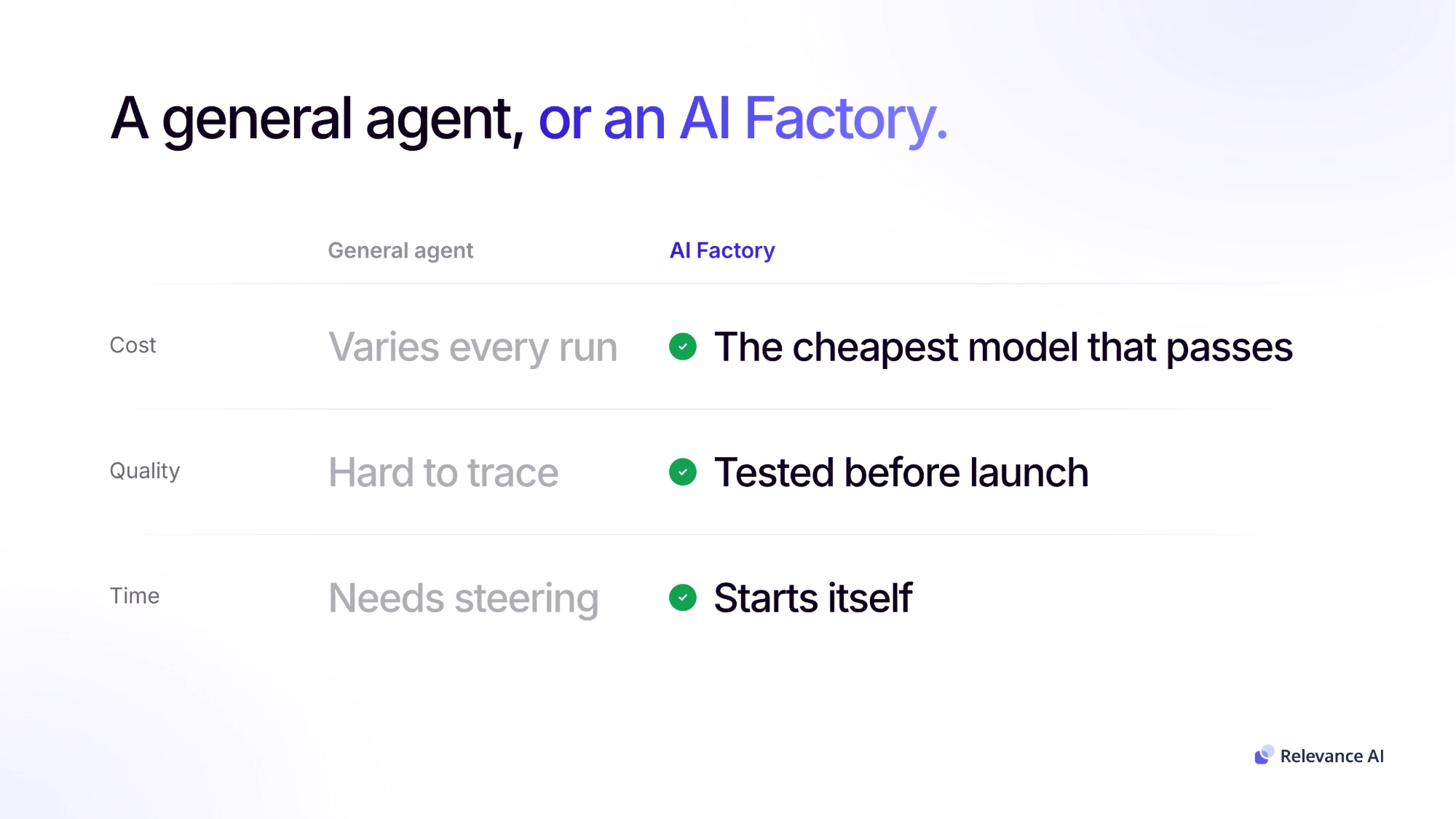
A general agent improvises every run, while a factory repeats a tested process at known cost.
What is a self-improving AI Factory?
Standalone agents lose value as the business and the market change. Someone has to keep retraining or redesigning them. A self-improving AI Factory compounds value instead. It runs two loops.
The first loop keeps the factory working. Your team defines quality checks for every agent, and the factory tracks performance against them in production. When an agent dips below standard, an alarm points straight to it. The fix can apply automatically, often overnight, or wait for a person to approve it. The same checks let each agent run on the cheapest model that still passes.
The second loop keeps the factory focused on the business. On a schedule, the factory goes into the systems where its work lands, such as the CRM. It traces the deals its agents touched and checks whether they produced results. Then it brings recommendations to the people in the control room: a new agent to build, a step to change, or a strategy to rethink.
Better models make the factory better too. Every new model release is a tailwind, not a migration project. Each agent already has its own tests. The factory runs a new model against those tests and switches only the steps where it passes. Your factory gets faster, cheaper, and more accurate as models improve, without a rebuild.
People stay in charge of the factory. They set its guardrails and checkpoints, review its dashboards, and approve the fixes it proposes. The repetitive steps run without them, and their time goes to customers and to improving the factory.
The goal is to redesign how work gets done, not to add a thin layer of AI on top.
How Relevance AI builds and runs your AI Factory
We believe our users shouldn’t be building agents at all. With Invent 2.0, the solutions engineer agent built into our platform, that becomes our job. Invent maps the process with your experts, builds the specialist agents, sets up the quality checks, and fixes what breaks.
Your team’s job is to be the authority on the process. Explain how your business works as clearly as possible, and decide what good looks like. That is what working in the control room means.
Every alternative leaves you to build the factory around the agents yourself:
- Foundation models and general assistants: you get capable models and faster individuals. Your team then builds and maintains evals, approvals, access control, monitoring, and cost tuning in-house.
- Point solutions: you get one task automated for one team. Processes that span teams and systems still need one place to govern them.
- Other agent platforms: you get tools to build and deploy agents. Keeping those agents valuable after launch stays your job.
On Relevance AI, the AI Factory comes with the platform. One factory can run across marketing, sales, and customer success toward one outcome. It measures its own impact, recommends improvements, and can fix itself. Domain experts, ops teams, and technical leaders work on one platform, governed from one place.
That governance satisfies business leaders and gives technology owners peace of mind. It covers access controls, flexible authentication, human approvals, version history, and monitoring. All of it runs on one vertically integrated, model-agnostic stack.
From manual production lines to AI Factories
Software engineering is already making the shift. Engineers used to write every feature by hand. Now many teams build the system that produces features, often called a software factory.
In these factories, teams of specialist agents take in tickets, plan the work, write the code, and test it. They ship it, monitor it in production, and fix what breaks, around the clock.
The engineers moved to the work agents can’t do. They build things that make it easier for factories to ship features faster. Every improvement they make to the system elevates every feature that comes after it.
Revenue teams are next. We help companies build the same system for their revenue engine. A pipeline generation factory might run separate production lines for inbound, outbound, event lead follow-up, and ABM. Every line feeds the same goal.
That is also why we have never built point solutions. An AI Factory has to work across a company’s systems and teams.
The manual production line is how most work happens today. People write the meeting follow-up, review the contract, research the account, update the CRM, and prepare the report.
Agents do what they are good at: high-volume, repeatable steps. People do what they are good at: judgment, relationships, and design.
Our job is to take the repetitive stations off your people’s hands. Then they spend their time where people win: with customers, and in the control room improving the factory.
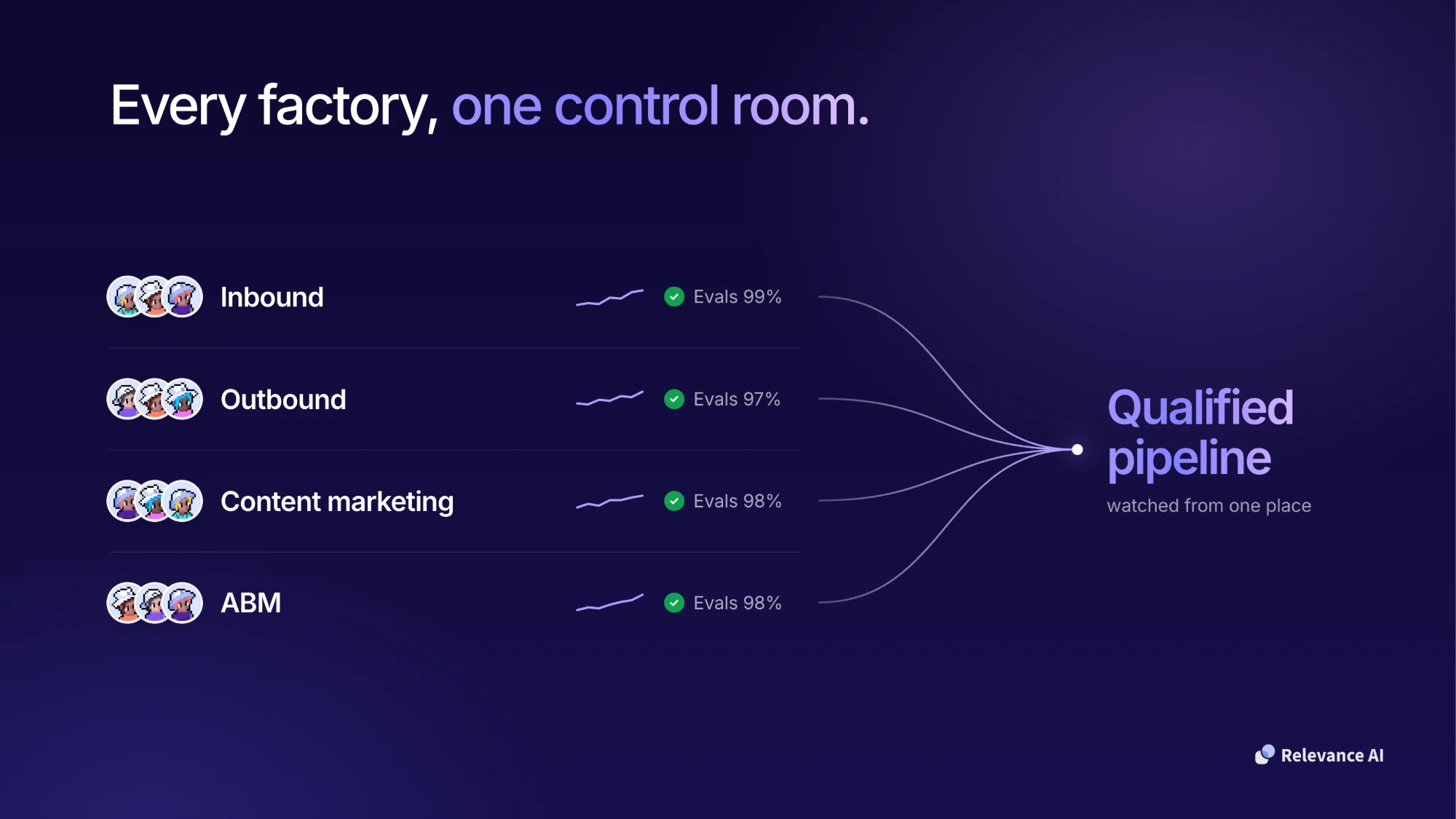
Each production line runs its own use case, and every line feeds the same pipeline goal.
AI Factories already running on Relevance AI
Our customers run AI Factories that generate millions of dollars in revenue. Each factory is measured on a business number, not on how many tasks its agents complete.
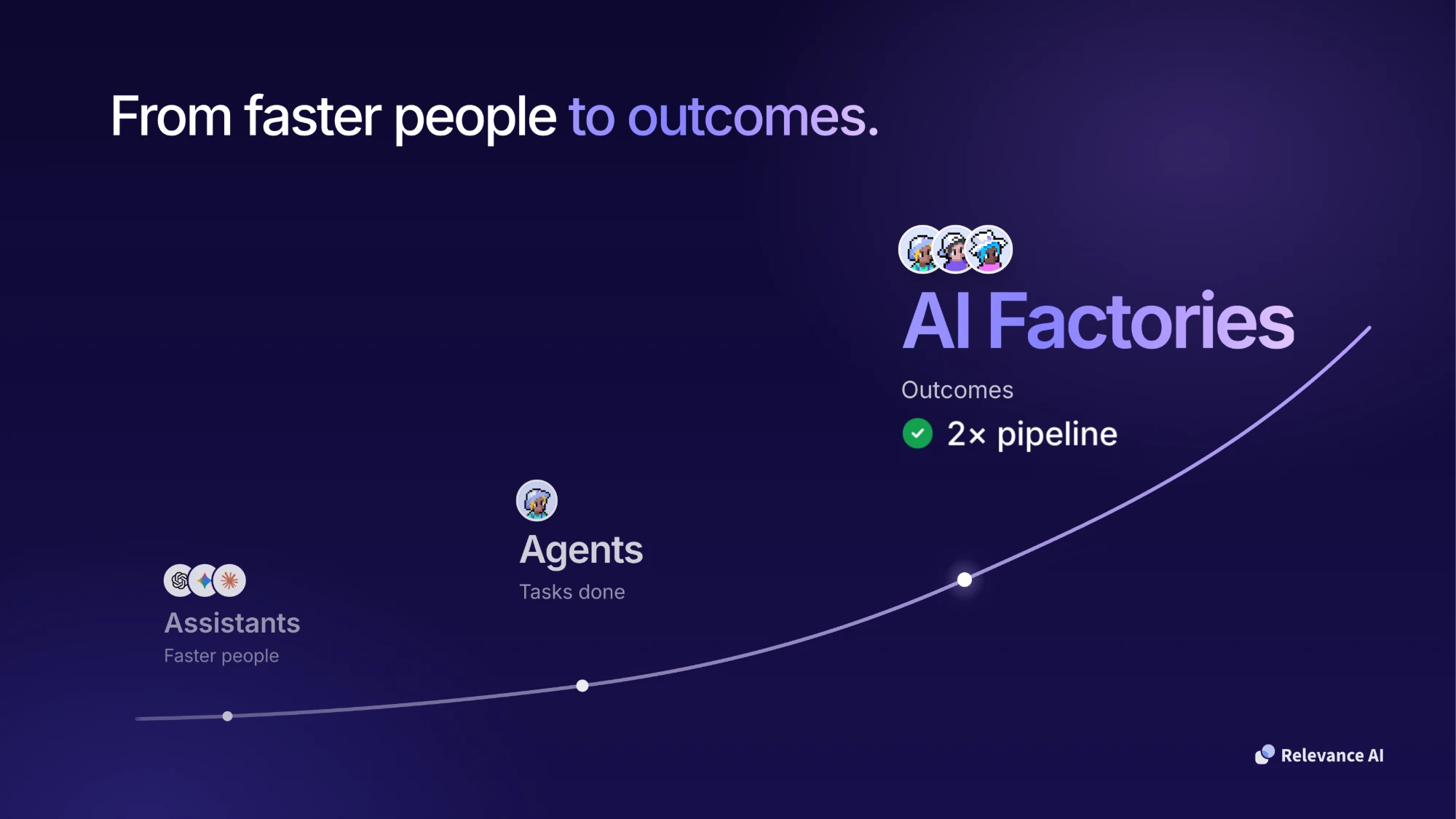
Assistants speed up people and agents finish tasks, but AI Factories deliver business outcomes.
Large tech company: 2x quarterly pipeline in six months
A 7,500-employee tech company launched a pipeline generation factory. Six months later, its quarterly pipeline had doubled.
SMB: $20,000+ in new business closed in three weeks
An SMB customer launched a signals production line that sweeps the CRM and learns from deals that progressed or closed. It closed more than $20,000 in new business within three weeks of launch.
Global tech company: over 1,000 sales reps supported by agents
A global technology company started with just one use case for one segment of their business. In 18 months, they expanded their PipeGen Factory to cover all segments in all regions, with over 850,000 tasks completed by agents over time.
The pattern repeats with every customer. Start with one production line and prove it against a number the business already trusts. Then extend the factory, with the people closest to the work defining each new process.
What a revenue org running an AI Factory looks like
The outbound, event follow-up, and ABM lines run the same way, all feeding one pipeline number. On Friday, the RevOps leader opens the factory dashboard. Pipeline shows by line, with the cost of every qualified meeting next to it.
One agent’s reply rate dipped midweek, and the factory has already proposed a fix. The RevOps leader approves it, then spends the afternoon with marketing redesigning the ABM line.
Nobody on the team built an agent that week. They spent their time with customers and in the control room. The factory handled the rest and got better while doing it.
That is the AI Factory.
That is the future of work.
And that is what we are delivering at Relevance AI.
Interested in learning more?
- Read the AI Factories datasheet on the Relevance AI Resources page.
- Drive more impact through AI workflows. Get the whitepaper, The Levels of AI Autonomy.
- Talk to an AI Factories expert - book a conversation.