6 min read

December 1, 2025

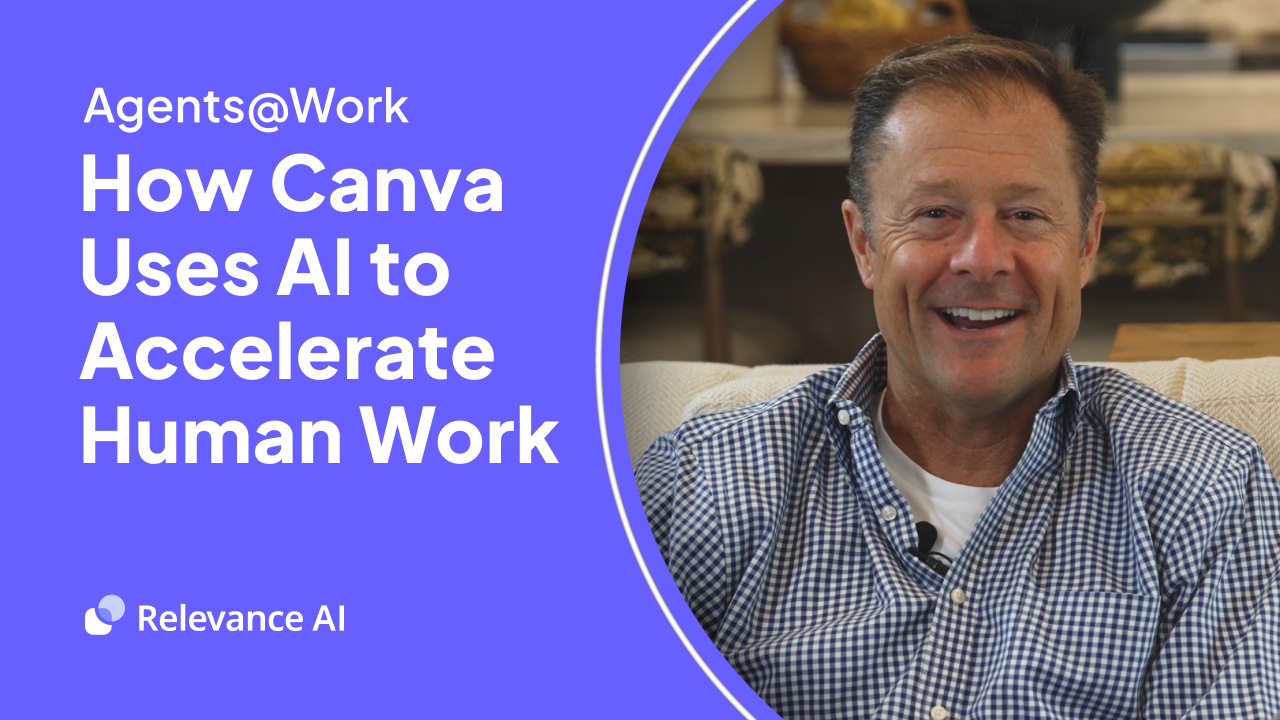
How Canva Uses AI to Accelerate Human Work

Share this post

https://relevanceai.com/blog/how-canva-uses-ai-to-accelerate-human-work

Daniel Vassilev

Founder

When you speak with Rob Giglio, Chief Customer Officer at Canva, you don't get vague speculation about AI. You get the unmistakable clarity of a company that knows exactly what work actually looks like—the real work inside sales calls, customer conversations, and ongoing relationships.

Talk to Jess Chiew, who leads GTM Strategy & Operations, and Michael Denari, Global Head of IT, and that clarity gets even sharper. You see how product, GTM, and IT work as one system: mapping the work, choosing the right bets, and turning AI agents into governed, production-grade workflows—not experiments.

That's why Canva is outpacing so many global enterprises in the shift to AI-accelerated execution. Not because they chase trends or treat AI as theatre, but because they anchor everything in the mission that defines them: empower the world to design.

From Operational Gravity to Concrete Time Back

Like every high-growth organization, Canva hit a moment where scale became both a blessing and a constraint. Customer conversations were rising, buyer research was accelerating, and expectations on responsiveness were increasing. Yet the work surrounding those conversations—preparation, research, documentation, follow-up—was growing even faster.

Rob described what every enterprise quietly knows: the real tax in GTM isn't the meeting. It's everything around it. These invisible layers drain time, fragment attention, and create enormous performance gaps.

Jess saw the same thing from the strategy side. Her team led a deliberate effort to find the drag in the system—first by looking at the business through data, then by shadowing AEs, BDRs, and CSMs to hear where they needed help.

The goal was not abstract innovation. It was concrete time back. Free up manual work so GTM teams can spend more time with customers, not less.

Instead of hiring around the problem or building new process layers, Canva made a different choice: they redesigned the rhythm of work.

Building an AI-First Culture: From "Fire Tornado" to Operating System

Michael describes the last two years bluntly: "My team likes to refer to it as the AI fire tornado—chaotic, fun, a big mix of emotions."

As an organization publicly committed to being AI-first, Canva deliberately leaned into that chaos. They made tools available for experimentation, then backed that intent with time and sponsorship.

One of the clearest expressions was AI Week: three days of company-wide training followed by a two-day hackathon focused purely on AI. It wasn't a side program—it was leadership signaling that AI is everyone's job.

But Canva didn't stop there. Each department owned what AI-first looked like locally. IT runs a weekly "Monday hour of power"—one hour every Monday dedicated to experimenting with AI. Other teams run quarterly deep-dives and recurring enablement sessions.

The result is a culture where AI isn't a central initiative that comes and goes. It's a habit—reinforced by leadership, but shaped by each team.

This philosophy extends to how they build products. Rob captures it perfectly: "Canva's mission has always been to make complex things simple. AI is the perfect catalyst to facilitate that." They don't use AI to mimic human creativity—they use it to remove the work that gets in the way of it.

The same thinking shapes their GTM approach. Rob is clear about where early value lies: "Recapping and preparing for calls is one of the biggest opportunities... That's where we're focusing." Save a rep 15 minutes preparing for a prospect call. Draft follow-up emails that maintain quality while removing repetition. These aren't moonshots on slideware—they unlock capacity and build trust.

From Jobs-to-Be-Done to Production-Grade Agents

A core part of Canva's AI motion is what Rob calls jobs-to-be-done mapping: "We pay very close attention to how customers move through the journey… Then we map the jobs to be done for all the people who help those customers. Being really clear on those jobs just pops out the areas to think about automating."

Jess' team turns that clarity into a roadmap, not a grab-bag of experiments. They deliberately did not start with tools: "That's a common trap with exciting new technologies. We started with where our business need lies."

Their criteria are blunt and familiar—the same ones used for annual planning:

- Will this free up time so reps can spend more time with customers?

- Will this help us close business faster?

- Will this onboard customers faster?

- Can we back it with clear ROI?

From there, they built a portfolio balancing quick wins (prove value, build credibility) with transformational projects (complex multi-step agent workflows treated like product launches).

"We didn't invent a new framework for AI. We used the same input metrics that already drive the value we care about," Jess explains. That discipline turns AI from pilots into an operating model.

One of Jess' biggest priorities was avoiding tool proliferation: "We're really loath to adding more tools and more surface area for our reps." That's why platforms like Relevance AI matter in Canva's strategy—they bring agents into existing surfaces like Slack and Salesforce rather than forcing teams to adopt yet another application.

Michael had a similar lens. In a world where IT is "politely swatting things down," Relevance stood out: "You look at the agent-first, intuitive builder, and it's super appealing for our internal AI efforts where we want to be at the forefront."

Governance as the Operating System for Velocity

Rob summarizes Canva's GTM–IT relationship simply: "IT provides the boundaries. GTM teams operate confidently inside them."

Michael's team makes those boundaries real—and flexible enough to scale. The non-negotiables for agents in production include role-based access control, monitoring and auditability, and scoped integrations per use case.

That's what allows Canva to move from one tightly controlled IT-run solution to a model where many teams can build on a shared platform, safely.

The rollout pattern is deliberate: start in a sandbox, use human-in-the-loop validation to vet outputs, then promote to production once accuracy is trusted.

Michael is brutally honest about the gap between prototype and value: "It's very easy to get something into prototype. It's very hard to get something into production. That's even more exaggerated with AI and agents."

Most enterprises treat governance as a blocker. Canva treats it as the operating system for velocity.

This operational rigor enabled them to create a dedicated GTM AI lead role—someone whose full-time job is to unblock complex, cross-team workflows. Since making that move, Canva has shipped faster, shipped more complex multi-step workflows, and built capabilities like Canva-specific account enrichment that generic vendors can't match.

Where This Is All Heading

Rob is clear-eyed about the shift happening across enterprise GTM: "Most big transactions today are seller-led; I think the balance is coming more in line between buyers and sellers... the timeline and efficiency will increase dramatically."

In that world, buyers show up more prepared than ever. They expect instant clarity, not gatekept information. They'll engage with agentic experiences on their own terms.

Rob believes this doesn't remove the seller—it elevates them. AI clears the operational fog so reps can show up sharper and more focused on the human parts of the job.

Michael's vision is equally straightforward: "We want every single employee using AI assistance every single day." The next frontier isn't just assistants—it's end-to-end business process agents that handle real workflows front-to-back.

Why Canva's Approach Matters

Across the enterprise stories we're releasing at Agents@Work, a consistent pattern emerges: the companies moving fastest are the ones with the clearest view of the work itself.

Canva's lessons are refreshingly practical:

✓ Start with the business and the work, not tools  

✓ Use real input metrics and ROI to prioritize  

✓ Balance quick wins with big bets  

✓ Avoid tool sprawl; bring agents into existing workflows  

✓ Build governance as a platform for velocity, not a gate  

✓ Invest in roles and rituals that make AI part of how you operate  

AI is not replacing the craft of GTM at Canva. It's sharpening it.

You don't need grand AI reinvention. You need clarity about the work. You need agents that accelerate execution. You need governance that keeps the rails secure. And you need a culture that moves forward without hesitation.

This is not theory. This is not a preview. This is what the modern enterprise looks like when mission, culture, and AI acceleration intersect—and Canva is showing the world what happens when humans and AI operate as a genuine workforce, each doing what they do best.

By Daniel Vassilev, Co-Founder & Co-CEO, Relevance AI

Watch the full interview premiering at Agents@Work, December 10 2025.

How Canva Uses AI to Accelerate Human Work

When you speak with Rob Giglio, Chief Customer Officer at Canva, you don't get vague speculation about AI. You get the unmistakable clarity of a company that knows exactly what work actually looks like—the real work inside sales calls, customer conversations, and ongoing relationships.

Talk to Jess Chiew, who leads GTM Strategy & Operations, and Michael Denari, Global Head of IT, and that clarity gets even sharper. You see how product, GTM, and IT work as one system: mapping the work, choosing the right bets, and turning AI agents into governed, production-grade workflows—not experiments.

That's why Canva is outpacing so many global enterprises in the shift to AI-accelerated execution. Not because they chase trends or treat AI as theatre, but because they anchor everything in the mission that defines them: empower the world to design.

From Operational Gravity to Concrete Time Back

Like every high-growth organization, Canva hit a moment where scale became both a blessing and a constraint. Customer conversations were rising, buyer research was accelerating, and expectations on responsiveness were increasing. Yet the work surrounding those conversations—preparation, research, documentation, follow-up—was growing even faster.

Rob described what every enterprise quietly knows: the real tax in GTM isn't the meeting. It's everything around it. These invisible layers drain time, fragment attention, and create enormous performance gaps.

Jess saw the same thing from the strategy side. Her team led a deliberate effort to find the drag in the system—first by looking at the business through data, then by shadowing AEs, BDRs, and CSMs to hear where they needed help.

The goal was not abstract innovation. It was concrete time back. Free up manual work so GTM teams can spend more time with customers, not less.

Instead of hiring around the problem or building new process layers, Canva made a different choice: they redesigned the rhythm of work.

Building an AI-First Culture: From "Fire Tornado" to Operating System

Michael describes the last two years bluntly: "My team likes to refer to it as the AI fire tornado—chaotic, fun, a big mix of emotions."

As an organization publicly committed to being AI-first, Canva deliberately leaned into that chaos. They made tools available for experimentation, then backed that intent with time and sponsorship.

One of the clearest expressions was AI Week: three days of company-wide training followed by a two-day hackathon focused purely on AI. It wasn't a side program—it was leadership signaling that AI is everyone's job.

But Canva didn't stop there. Each department owned what AI-first looked like locally. IT runs a weekly "Monday hour of power"—one hour every Monday dedicated to experimenting with AI. Other teams run quarterly deep-dives and recurring enablement sessions.

The result is a culture where AI isn't a central initiative that comes and goes. It's a habit—reinforced by leadership, but shaped by each team.

This philosophy extends to how they build products. Rob captures it perfectly: "Canva's mission has always been to make complex things simple. AI is the perfect catalyst to facilitate that." They don't use AI to mimic human creativity—they use it to remove the work that gets in the way of it.

The same thinking shapes their GTM approach. Rob is clear about where early value lies: "Recapping and preparing for calls is one of the biggest opportunities... That's where we're focusing." Save a rep 15 minutes preparing for a prospect call. Draft follow-up emails that maintain quality while removing repetition. These aren't moonshots on slideware—they unlock capacity and build trust.

From Jobs-to-Be-Done to Production-Grade Agents

A core part of Canva's AI motion is what Rob calls jobs-to-be-done mapping: "We pay very close attention to how customers move through the journey… Then we map the jobs to be done for all the people who help those customers. Being really clear on those jobs just pops out the areas to think about automating."

Jess' team turns that clarity into a roadmap, not a grab-bag of experiments. They deliberately did not start with tools: "That's a common trap with exciting new technologies. We started with where our business need lies."

Their criteria are blunt and familiar—the same ones used for annual planning:

- Will this free up time so reps can spend more time with customers?

- Will this help us close business faster?

- Will this onboard customers faster?

- Can we back it with clear ROI?

From there, they built a portfolio balancing quick wins (prove value, build credibility) with transformational projects (complex multi-step agent workflows treated like product launches).

"We didn't invent a new framework for AI. We used the same input metrics that already drive the value we care about," Jess explains. That discipline turns AI from pilots into an operating model.

One of Jess' biggest priorities was avoiding tool proliferation: "We're really loath to adding more tools and more surface area for our reps." That's why platforms like Relevance AI matter in Canva's strategy—they bring agents into existing surfaces like Slack and Salesforce rather than forcing teams to adopt yet another application.

Michael had a similar lens. In a world where IT is "politely swatting things down," Relevance stood out: "You look at the agent-first, intuitive builder, and it's super appealing for our internal AI efforts where we want to be at the forefront."

Governance as the Operating System for Velocity

Rob summarizes Canva's GTM–IT relationship simply: "IT provides the boundaries. GTM teams operate confidently inside them."

Michael's team makes those boundaries real—and flexible enough to scale. The non-negotiables for agents in production include role-based access control, monitoring and auditability, and scoped integrations per use case.

That's what allows Canva to move from one tightly controlled IT-run solution to a model where many teams can build on a shared platform, safely.

The rollout pattern is deliberate: start in a sandbox, use human-in-the-loop validation to vet outputs, then promote to production once accuracy is trusted.

Michael is brutally honest about the gap between prototype and value: "It's very easy to get something into prototype. It's very hard to get something into production. That's even more exaggerated with AI and agents."

Most enterprises treat governance as a blocker. Canva treats it as the operating system for velocity.

This operational rigor enabled them to create a dedicated GTM AI lead role—someone whose full-time job is to unblock complex, cross-team workflows. Since making that move, Canva has shipped faster, shipped more complex multi-step workflows, and built capabilities like Canva-specific account enrichment that generic vendors can't match.

Where This Is All Heading

Rob is clear-eyed about the shift happening across enterprise GTM: "Most big transactions today are seller-led; I think the balance is coming more in line between buyers and sellers... the timeline and efficiency will increase dramatically."

In that world, buyers show up more prepared than ever. They expect instant clarity, not gatekept information. They'll engage with agentic experiences on their own terms.

Rob believes this doesn't remove the seller—it elevates them. AI clears the operational fog so reps can show up sharper and more focused on the human parts of the job.

Michael's vision is equally straightforward: "We want every single employee using AI assistance every single day." The next frontier isn't just assistants—it's end-to-end business process agents that handle real workflows front-to-back.

Why Canva's Approach Matters

Across the enterprise stories we're releasing at Agents@Work, a consistent pattern emerges: the companies moving fastest are the ones with the clearest view of the work itself.

Canva's lessons are refreshingly practical:

✓ Start with the business and the work, not tools  

✓ Use real input metrics and ROI to prioritize  

✓ Balance quick wins with big bets  

✓ Avoid tool sprawl; bring agents into existing workflows  

✓ Build governance as a platform for velocity, not a gate  

✓ Invest in roles and rituals that make AI part of how you operate  

AI is not replacing the craft of GTM at Canva. It's sharpening it.

You don't need grand AI reinvention. You need clarity about the work. You need agents that accelerate execution. You need governance that keeps the rails secure. And you need a culture that moves forward without hesitation.

This is not theory. This is not a preview. This is what the modern enterprise looks like when mission, culture, and AI acceleration intersect—and Canva is showing the world what happens when humans and AI operate as a genuine workforce, each doing what they do best.

By Daniel Vassilev, Co-Founder & Co-CEO, Relevance AI

Watch the full interview premiering at Agents@Work, December 10 2025.

Contents
Daniel Vassilev
Tags:
Insights