6 min read

December 1, 2025

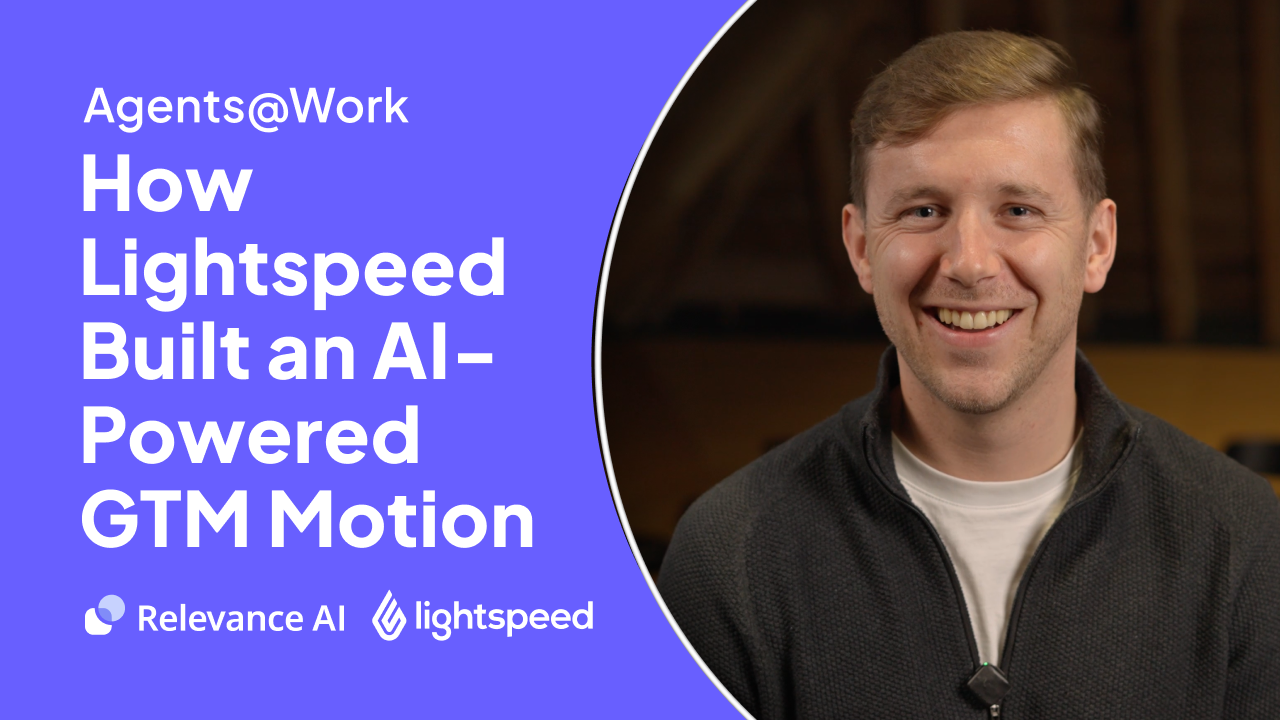
How Lightspeed Built an AI-Powered GTM Motion

Share this post

https://relevanceai.com/blog/how-lightspeed-built-an-ai-powered-gtm-motion----and-the-builder-who-turned-it-into-alex

Daniel Vassilev

Founder

When you walk into Lightspeed's headquarters in Montreal, you feel the weight of history before a single conversation begins. The building started life as a train station, became a hotel, and today houses one of the world's leading commerce technology companies. It's a reminder that reinvention isn't a clean break—it's layers evolved with purpose.

During my conversations with Remi Pinteau, Director of Performance Marketing, it became clear immediately: this is not another enterprise "AI pilot." Lightspeed isn't dabbling. They're building something far more intentional—a cross-functional motion where AI protects human attention, accelerates the customer journey, and amplifies the work that genuinely moves the business.

Later, when we spoke with Miles Smith—now Senior Marketing AI Technologist—that structure took human form. You see a practitioner who grew up inside growth marketing, got obsessed with AI early, and helped turn strategy into something real: a functioning agent called Alex that now works alongside hundreds of sales reps globally.

Together, their story reveals the real truth behind Lightspeed's AI progress: AI success isn't a technical story. It's an operational one—shaped by people, discipline, and a deep respect for human work.

The Foundation: Structure Before Speed

Lightspeed began in 2005 as a Montreal-based point-of-sale platform. Two decades later, it powers thousands of businesses across retail, hospitality, restaurants, and golf—the heartbeat of local commerce. That context sets a hard reality: there is no room for inefficiency, no room for bloated workflows, no room for experiments that don't translate into operational outcomes.

So when large language models became viable, Lightspeed didn't get stuck in "what if?" discussions. As Remi puts it, the opportunity was obvious—the real question was sequencing and structure. Before deploying a single agent, Remi aligned the organization on a deceptively simple north star: Free people to do the work only humans can do.

That principle shaped everything: save time, move faster, automate the repetitive, protect the human relationship. In Lightspeed's world, relationships are the multiplier. They drive trust with merchants, shape pipeline, and power retention. AI wasn't introduced to replace any of that—it was introduced to preserve and elevate it by removing the manual drag that pulls people out of conversations, strategy, and judgment.

Most enterprises deploy AI in pockets. Lightspeed did the opposite—they built the frame before the acceleration. Under Remi's leadership, they mapped GTM work from outcomes down to tasks, prioritized the few use cases that mattered most, defined KPIs upfront (primary, secondary, and quality measures), and created a cross-functional AI pod that included comms, content, automation, systems, IT, privacy, and compliance. It wasn't glamorous. It wasn't fast. But it created a level of alignment most enterprises never reach.

If Remi defined the direction, Miles became one of its architects. Before stepping into his AI role, Miles spent years in performance marketing across APAC—deep in paid media, landing pages, and analytics. When ChatGPT arrived, that interaction fundamentally shifted how he saw his craft. He began applying AI to landing page optimization, creative workflows, and analytics. The results were immediate. Remi and Richard pulled him into a cross-functional pod—eventually co-leading the Relevance AI rollout with Leslie and the Marketing AI Pod.

Miles split his learning into two phases he still follows rigorously: explore—understand the landscape, study patterns, learn the guardrails; then exploit—apply that understanding to business problems with discipline. Through the AI Ops course and deep collaboration with the Relevance team, the distinction snapped into place: workflows automate steps, agents accelerate judgment. Workflows are predictable. Agents behave. Workflows follow instructions. Agents pursue outcomes.

The Agent: Building Alex the Right Way

Lightspeed's GTM teams now work alongside Alex—a closed-lost research and outreach assistant that investigates closed-lost segments, drafts outreach, and hands off cleanly to sales reps. What sounds simple on paper is anything but. Lightspeed operates with hundreds of sales reps worldwide, dozens of regional nuances, a diverse complex tech stack, and data that isn't always complete or uniform. Alex had to fit into that world—not the other way around.

The team built it using a crawl–walk–run rhythm: start small, observe behavior, improve accuracy, strengthen guardrails, expand deliberately. Each iteration surfaced hidden friction in systems, workflows, and assumptions. Alex wasn't "launched." Alex was raised.

From the start, the goal was to encode the way Lightspeed actually sells. Miles and the AI pod partnered with sales SMEs, studied top performers, interviewed champions across regions, mapped their decision logic, and collaborated with security, privacy, and legal. With the Relevance team—especially Michael and Ishika—they turned those insights into detailed process maps. Stakeholders across sales, marketing, systems, and compliance reviewed and signed off before Alex ever touched a live customer.

Miles calls this alignment one of the highest-value outcomes of the entire project. Even without AI, the organization is stronger for having codified its best work.

Remi summarizes their governance in three principles:

1) Minimize privileges—agents get only the access they need.

2) Crawl → walk → run—volume increases only when confidence increases.

3) Maintain human-in-the-loop—automation doesn't replace oversight. In the early phases, the team manually reviewed every research report, every email, every response, every behavior pattern. Trust was earned, not assumed.

Performance is part of Lightspeed's DNA. They track pipeline generation as the primary KPI, quality scores, accuracy benchmarking, throughput analysis, and comparison to baseline human workflows. Growth marketing expanded its definition of "performance" to include labor productivity—a shift many enterprises haven't made. They have reporting structures to quantify value and can articulate Alex's impact with clarity. This is what separates real AI adoption from AI theater.

What It Means

Ask Remi about the future and he's direct: agents will become operational assistants—researching, preparing, drafting, accelerating—so humans can go deeper into meaning, strategy, and relationships. Miles imagines ambient agents running in the background, sales reps interacting with agents across Slack and chat, and humans focusing on momentum, guidance, and understanding merchants. Now that they've proven value and integrated agents into real systems: "The sky's the limit—the next challenge is scaling horizontally."

Through Remi, you see the leader who built the engine—structure-first, outcome-driven, governed with care. Through Miles, you see the practitioner who brought it to life—curious, disciplined, and unwilling to settle for AI that just looks impressive. Together they show what modern AI adoption actually looks like: not hype, not theory, but human-first acceleration.

Their story reveals three lessons every enterprise will eventually discover: domain teams must be empowered as builders, governance and iteration are non-negotiable, and the real value emerges when agents are embedded into everyday work.

Lightspeed didn't chase the trend. They built the discipline. And because of that, their teams are now working alongside agents—not as replacements, but as teammates. That's why Lightspeed isn't just adopting AI. They're showing what it looks like when a global enterprise brings AI into the rhythm of real work.

By Daniel Vassilev, Co-Founder & Co-CEO, Relevance AI

Watch the full interview premiering at Agents@Work, December 10 2025.

How Lightspeed Built an AI-Powered GTM Motion

When you walk into Lightspeed's headquarters in Montreal, you feel the weight of history before a single conversation begins. The building started life as a train station, became a hotel, and today houses one of the world's leading commerce technology companies. It's a reminder that reinvention isn't a clean break—it's layers evolved with purpose.

During my conversations with Remi Pinteau, Director of Performance Marketing, it became clear immediately: this is not another enterprise "AI pilot." Lightspeed isn't dabbling. They're building something far more intentional—a cross-functional motion where AI protects human attention, accelerates the customer journey, and amplifies the work that genuinely moves the business.

Later, when we spoke with Miles Smith—now Senior Marketing AI Technologist—that structure took human form. You see a practitioner who grew up inside growth marketing, got obsessed with AI early, and helped turn strategy into something real: a functioning agent called Alex that now works alongside hundreds of sales reps globally.

Together, their story reveals the real truth behind Lightspeed's AI progress: AI success isn't a technical story. It's an operational one—shaped by people, discipline, and a deep respect for human work.

The Foundation: Structure Before Speed

Lightspeed began in 2005 as a Montreal-based point-of-sale platform. Two decades later, it powers thousands of businesses across retail, hospitality, restaurants, and golf—the heartbeat of local commerce. That context sets a hard reality: there is no room for inefficiency, no room for bloated workflows, no room for experiments that don't translate into operational outcomes.

So when large language models became viable, Lightspeed didn't get stuck in "what if?" discussions. As Remi puts it, the opportunity was obvious—the real question was sequencing and structure. Before deploying a single agent, Remi aligned the organization on a deceptively simple north star: Free people to do the work only humans can do.

That principle shaped everything: save time, move faster, automate the repetitive, protect the human relationship. In Lightspeed's world, relationships are the multiplier. They drive trust with merchants, shape pipeline, and power retention. AI wasn't introduced to replace any of that—it was introduced to preserve and elevate it by removing the manual drag that pulls people out of conversations, strategy, and judgment.

Most enterprises deploy AI in pockets. Lightspeed did the opposite—they built the frame before the acceleration. Under Remi's leadership, they mapped GTM work from outcomes down to tasks, prioritized the few use cases that mattered most, defined KPIs upfront (primary, secondary, and quality measures), and created a cross-functional AI pod that included comms, content, automation, systems, IT, privacy, and compliance. It wasn't glamorous. It wasn't fast. But it created a level of alignment most enterprises never reach.

If Remi defined the direction, Miles became one of its architects. Before stepping into his AI role, Miles spent years in performance marketing across APAC—deep in paid media, landing pages, and analytics. When ChatGPT arrived, that interaction fundamentally shifted how he saw his craft. He began applying AI to landing page optimization, creative workflows, and analytics. The results were immediate. Remi and Richard pulled him into a cross-functional pod—eventually co-leading the Relevance AI rollout with Leslie and the Marketing AI Pod.

Miles split his learning into two phases he still follows rigorously: explore—understand the landscape, study patterns, learn the guardrails; then exploit—apply that understanding to business problems with discipline. Through the AI Ops course and deep collaboration with the Relevance team, the distinction snapped into place: workflows automate steps, agents accelerate judgment. Workflows are predictable. Agents behave. Workflows follow instructions. Agents pursue outcomes.

The Agent: Building Alex the Right Way

Lightspeed's GTM teams now work alongside Alex—a closed-lost research and outreach assistant that investigates closed-lost segments, drafts outreach, and hands off cleanly to sales reps. What sounds simple on paper is anything but. Lightspeed operates with hundreds of sales reps worldwide, dozens of regional nuances, a diverse complex tech stack, and data that isn't always complete or uniform. Alex had to fit into that world—not the other way around.

The team built it using a crawl–walk–run rhythm: start small, observe behavior, improve accuracy, strengthen guardrails, expand deliberately. Each iteration surfaced hidden friction in systems, workflows, and assumptions. Alex wasn't "launched." Alex was raised.

From the start, the goal was to encode the way Lightspeed actually sells. Miles and the AI pod partnered with sales SMEs, studied top performers, interviewed champions across regions, mapped their decision logic, and collaborated with security, privacy, and legal. With the Relevance team—especially Michael and Ishika—they turned those insights into detailed process maps. Stakeholders across sales, marketing, systems, and compliance reviewed and signed off before Alex ever touched a live customer.

Miles calls this alignment one of the highest-value outcomes of the entire project. Even without AI, the organization is stronger for having codified its best work.

Remi summarizes their governance in three principles:

1) Minimize privileges—agents get only the access they need.

2) Crawl → walk → run—volume increases only when confidence increases.

3) Maintain human-in-the-loop—automation doesn't replace oversight. In the early phases, the team manually reviewed every research report, every email, every response, every behavior pattern. Trust was earned, not assumed.

Performance is part of Lightspeed's DNA. They track pipeline generation as the primary KPI, quality scores, accuracy benchmarking, throughput analysis, and comparison to baseline human workflows. Growth marketing expanded its definition of "performance" to include labor productivity—a shift many enterprises haven't made. They have reporting structures to quantify value and can articulate Alex's impact with clarity. This is what separates real AI adoption from AI theater.

What It Means

Ask Remi about the future and he's direct: agents will become operational assistants—researching, preparing, drafting, accelerating—so humans can go deeper into meaning, strategy, and relationships. Miles imagines ambient agents running in the background, sales reps interacting with agents across Slack and chat, and humans focusing on momentum, guidance, and understanding merchants. Now that they've proven value and integrated agents into real systems: "The sky's the limit—the next challenge is scaling horizontally."

Through Remi, you see the leader who built the engine—structure-first, outcome-driven, governed with care. Through Miles, you see the practitioner who brought it to life—curious, disciplined, and unwilling to settle for AI that just looks impressive. Together they show what modern AI adoption actually looks like: not hype, not theory, but human-first acceleration.

Their story reveals three lessons every enterprise will eventually discover: domain teams must be empowered as builders, governance and iteration are non-negotiable, and the real value emerges when agents are embedded into everyday work.

Lightspeed didn't chase the trend. They built the discipline. And because of that, their teams are now working alongside agents—not as replacements, but as teammates. That's why Lightspeed isn't just adopting AI. They're showing what it looks like when a global enterprise brings AI into the rhythm of real work.

By Daniel Vassilev, Co-Founder & Co-CEO, Relevance AI

Watch the full interview premiering at Agents@Work, December 10 2025.

Contents
Daniel Vassilev
Tags:
Insights