6 min read

December 8, 2025

Lessons From Lightspeed’s AI Leaders — The Practical Playbook Behind Their AI Workforce

Share this post

https://relevanceai.com/blog/lessons-from-lightspeeds-ai-leaders----the-practical-playbook-behind-their-ai-workforce

Daniel Vassilev

Founder

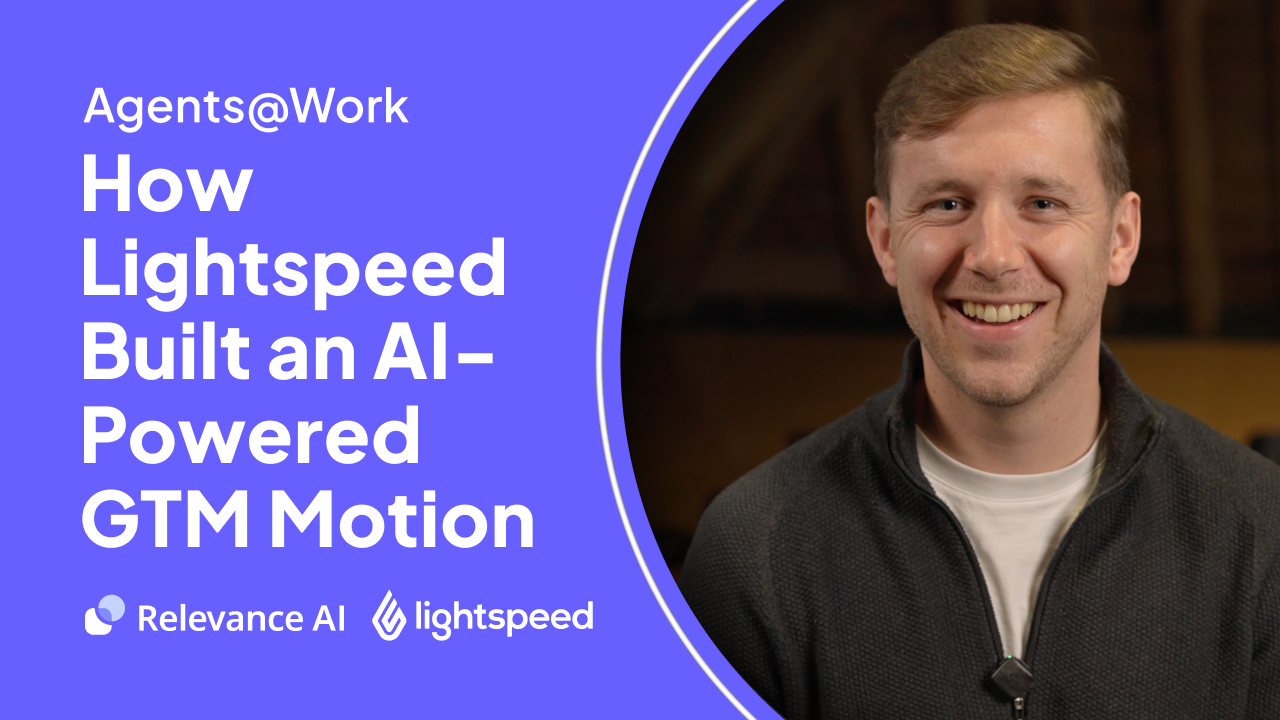
Through their conversations, Remi Pinto, Director of Performance Marketing, and Miles Smith, Senior AI Marketing Technologist, unpack how Lightspeed Commerce successfully embedded AI agents into sales and marketing workflows.

This article distills the most practical insights from their journey — the frameworks, safeguards, and operating principles that transformed AI from experimentation into everyday impact. It also serves as a guide for teams looking to meaningfully leverage AI but unsure where to begin.

1. Why Lightspeed Adopted AI Agents

Lightspeed began by recognising a simple truth: They needed a way to move faster, scale intelligently, and free humans to focus on high-value work. AI agents became the lever.

Drivers

- Hours → minutes efficiency gains
Manual prospect research, email drafting, and data compilation that once took hours could now be completed by agents in minutes.

- Removal of repetitive tasks
Agents took over high-volume, low-value tasks (e.g., initial outreach, research summaries), enabling teams to focus on customer conversations and strategic work.

- More personalised outreach at scale
Agents generated tailored emails and insights for thousands of prospects—something impossible for humans alone.

- Deeper, faster prospect research
Agents aggregated insights from multiple systems instantly, giving sellers richer context before reaching out.

2. The Crawl → Walk → Run Approach

Rather than scaling prematurely, Lightspeed built discipline into the rollout. Their staged model helped them learn safely, build trust, and refine continuously.

Crawl

- Start with small batches so issues can be spotted early without risk
- Human approval of every output
- Early discovery of failure modes


Walk

- Gradual volume increases
- Prompt/tool refinements
- Clear cross-functional alignment

Run

-Automation only after stable quality
- Ongoing monitoring
-Reusable components for new agents

3. The Cross-Functional Pod

Lightspeed formed an AI Marketing Pod pulling expertise from every part of the GTM and technical organisation. This ensured agents reflected real processes and passed all internal requirements.

Pod members

Sales SMEs • Growth & Marketing • Content & Brand • Marketing Automation • Security • Legal • Data/Systems


4. How Lightspeed Built “Domain-True” Agents

Agents don’t work if they’re generic. Lightspeed embedded deep internal expertise to ensure every agent mirrored how top performers actually operate.

How they did it

- Interviewed high-performing reps
- Mapped current → future-state workflows
- Co-designed the ideal agent with sales, brand, legal, and security
- Used this as the “source of truth” for the build

5. Safety, Governance & Trust

From day one, safety was treated as part of the build—not a final checkpoint. This is what built company-wide trust.

Some of their safeguards

- Human-in-the-loop approvals
Nothing went out to prospects without human review until quality was proven.

- Minimal-privilege permissions
Agents only accessed the specific data needed for their task—nothing more.

- Structured QC cycles
Weekly reviews of output quality, error logs, and edge cases drove continuous improvement.

- Early involvement from Privacy, Security & Legal
These teams shaped the rules and guardrails, building trust from day one.


6. Measuring Success

Lightspeed blended performance marketing metrics with new labour productivity and agent performance metrics to capture the full value.

What they tracked

- Research + outreach quality - Accuracy, tone, brand fit, and usefulness to reps.

- Agent failure modes - Identifying where outputs broke down (e.g., missing data, incorrect conclusions).

- Time and cost savings - Hours saved per rep per week, automation rates, and cost efficiencies.

- Pipeline, meetings, sales velocity - Tangible commercial impact tied back to agent activity.

- Custom dashboards benchmarking agents vs. humans - Clear visibility into performance gaps, improvements, and ROI.


7. Lessons Learned

Across both interviews, a few truths stood out:

- Quality first — early speed creates later problems

- Expect roadblocks — they’re part of the process

- Iterate constantly — best agents emerge from refinement

- Prioritise — limited bandwidth means focus matters

- Communicate — alignment sustains excitement and trust


8. Lightspeed’s Agents

Alex — the flagship agent

Researches prospects, crafts outreach, handles replies, and hands over to reps seamlessly — embedded in a complex global sales stack.

Now, Lightspeed is extracting reusable modules (like research components) to accelerate new agents across GTM, SEO, CRO and paid media.


9. What’s Next

With Alex proven, Lightspeed is expanding the AI Workforce:

- More communication channels
- Standalone research tools for reps to use on demand
- Agents for new GTM teams beyond sales and performance marketing
- Department-wide pilots to validate horizontal expansion
- Faster builds using shared modules and existing infrastructure

Miles describes the future as ambient agents—working invisibly behind the scenes to empower humans.


10. Advice for Getting Started

Remi and Miles’ guidance is simple:

- Start with one high-value use case
- Build trust through controlled rollout
- Bring in experts early (sales, brand, legal, security)
- Document fail cases
- Blend domain expertise with agent autonomy
- Give agents an identity (Lightspeed named theirs “Alex”)

Lightspeed’s experience is a reminder that AI success isn’t magic — it’s method. And with the right approach, any team can begin its own AI Workforce journey.

Lessons From Lightspeed’s AI Leaders — The Practical Playbook Behind Their AI Workforce

Through their conversations, Remi Pinto, Director of Performance Marketing, and Miles Smith, Senior AI Marketing Technologist, unpack how Lightspeed Commerce successfully embedded AI agents into sales and marketing workflows.

This article distills the most practical insights from their journey — the frameworks, safeguards, and operating principles that transformed AI from experimentation into everyday impact. It also serves as a guide for teams looking to meaningfully leverage AI but unsure where to begin.

1. Why Lightspeed Adopted AI Agents

Lightspeed began by recognising a simple truth: They needed a way to move faster, scale intelligently, and free humans to focus on high-value work. AI agents became the lever.

Drivers

- Hours → minutes efficiency gains
Manual prospect research, email drafting, and data compilation that once took hours could now be completed by agents in minutes.

- Removal of repetitive tasks
Agents took over high-volume, low-value tasks (e.g., initial outreach, research summaries), enabling teams to focus on customer conversations and strategic work.

- More personalised outreach at scale
Agents generated tailored emails and insights for thousands of prospects—something impossible for humans alone.

- Deeper, faster prospect research
Agents aggregated insights from multiple systems instantly, giving sellers richer context before reaching out.

2. The Crawl → Walk → Run Approach

Rather than scaling prematurely, Lightspeed built discipline into the rollout. Their staged model helped them learn safely, build trust, and refine continuously.

Crawl

- Start with small batches so issues can be spotted early without risk
- Human approval of every output
- Early discovery of failure modes


Walk

- Gradual volume increases
- Prompt/tool refinements
- Clear cross-functional alignment

Run

-Automation only after stable quality
- Ongoing monitoring
-Reusable components for new agents

3. The Cross-Functional Pod

Lightspeed formed an AI Marketing Pod pulling expertise from every part of the GTM and technical organisation. This ensured agents reflected real processes and passed all internal requirements.

Pod members

Sales SMEs • Growth & Marketing • Content & Brand • Marketing Automation • Security • Legal • Data/Systems


4. How Lightspeed Built “Domain-True” Agents

Agents don’t work if they’re generic. Lightspeed embedded deep internal expertise to ensure every agent mirrored how top performers actually operate.

How they did it

- Interviewed high-performing reps
- Mapped current → future-state workflows
- Co-designed the ideal agent with sales, brand, legal, and security
- Used this as the “source of truth” for the build

5. Safety, Governance & Trust

From day one, safety was treated as part of the build—not a final checkpoint. This is what built company-wide trust.

Some of their safeguards

- Human-in-the-loop approvals
Nothing went out to prospects without human review until quality was proven.

- Minimal-privilege permissions
Agents only accessed the specific data needed for their task—nothing more.

- Structured QC cycles
Weekly reviews of output quality, error logs, and edge cases drove continuous improvement.

- Early involvement from Privacy, Security & Legal
These teams shaped the rules and guardrails, building trust from day one.


6. Measuring Success

Lightspeed blended performance marketing metrics with new labour productivity and agent performance metrics to capture the full value.

What they tracked

- Research + outreach quality - Accuracy, tone, brand fit, and usefulness to reps.

- Agent failure modes - Identifying where outputs broke down (e.g., missing data, incorrect conclusions).

- Time and cost savings - Hours saved per rep per week, automation rates, and cost efficiencies.

- Pipeline, meetings, sales velocity - Tangible commercial impact tied back to agent activity.

- Custom dashboards benchmarking agents vs. humans - Clear visibility into performance gaps, improvements, and ROI.


7. Lessons Learned

Across both interviews, a few truths stood out:

- Quality first — early speed creates later problems

- Expect roadblocks — they’re part of the process

- Iterate constantly — best agents emerge from refinement

- Prioritise — limited bandwidth means focus matters

- Communicate — alignment sustains excitement and trust


8. Lightspeed’s Agents

Alex — the flagship agent

Researches prospects, crafts outreach, handles replies, and hands over to reps seamlessly — embedded in a complex global sales stack.

Now, Lightspeed is extracting reusable modules (like research components) to accelerate new agents across GTM, SEO, CRO and paid media.


9. What’s Next

With Alex proven, Lightspeed is expanding the AI Workforce:

- More communication channels
- Standalone research tools for reps to use on demand
- Agents for new GTM teams beyond sales and performance marketing
- Department-wide pilots to validate horizontal expansion
- Faster builds using shared modules and existing infrastructure

Miles describes the future as ambient agents—working invisibly behind the scenes to empower humans.


10. Advice for Getting Started

Remi and Miles’ guidance is simple:

- Start with one high-value use case
- Build trust through controlled rollout
- Bring in experts early (sales, brand, legal, security)
- Document fail cases
- Blend domain expertise with agent autonomy
- Give agents an identity (Lightspeed named theirs “Alex”)

Lightspeed’s experience is a reminder that AI success isn’t magic — it’s method. And with the right approach, any team can begin its own AI Workforce journey.

Contents
Daniel Vassilev
Tags:
Insights