Picture your top SDR on a Tuesday afternoon. She has four AI tools open and a queue of AI-drafted emails waiting for her approval. Her team adopted AI faster than anyone else in the company. So why hasn’t pipeline budged?
Your SDR has plenty of company. Enterprises poured $30 - 40 billion into generative AI, and MIT’s NANDA research team found that 95% of organizations saw zero return to the bottom line. And most of this AI isn’t agentic, it’s chat assistants. Gartner found that only 17% of organizations have deployed AI agents so far, while 42% of surveyed leaders expect to deploy them within a year.
More spending won’t necessarily fix the SDR’s problem, because the teams seeing outsize returns don’t necessarily own more AI. It’s that more of their AI is agentic, and their agents accomplish more of the work without a person steering it. Here at Relevance, we call this capability “AI autonomy.”
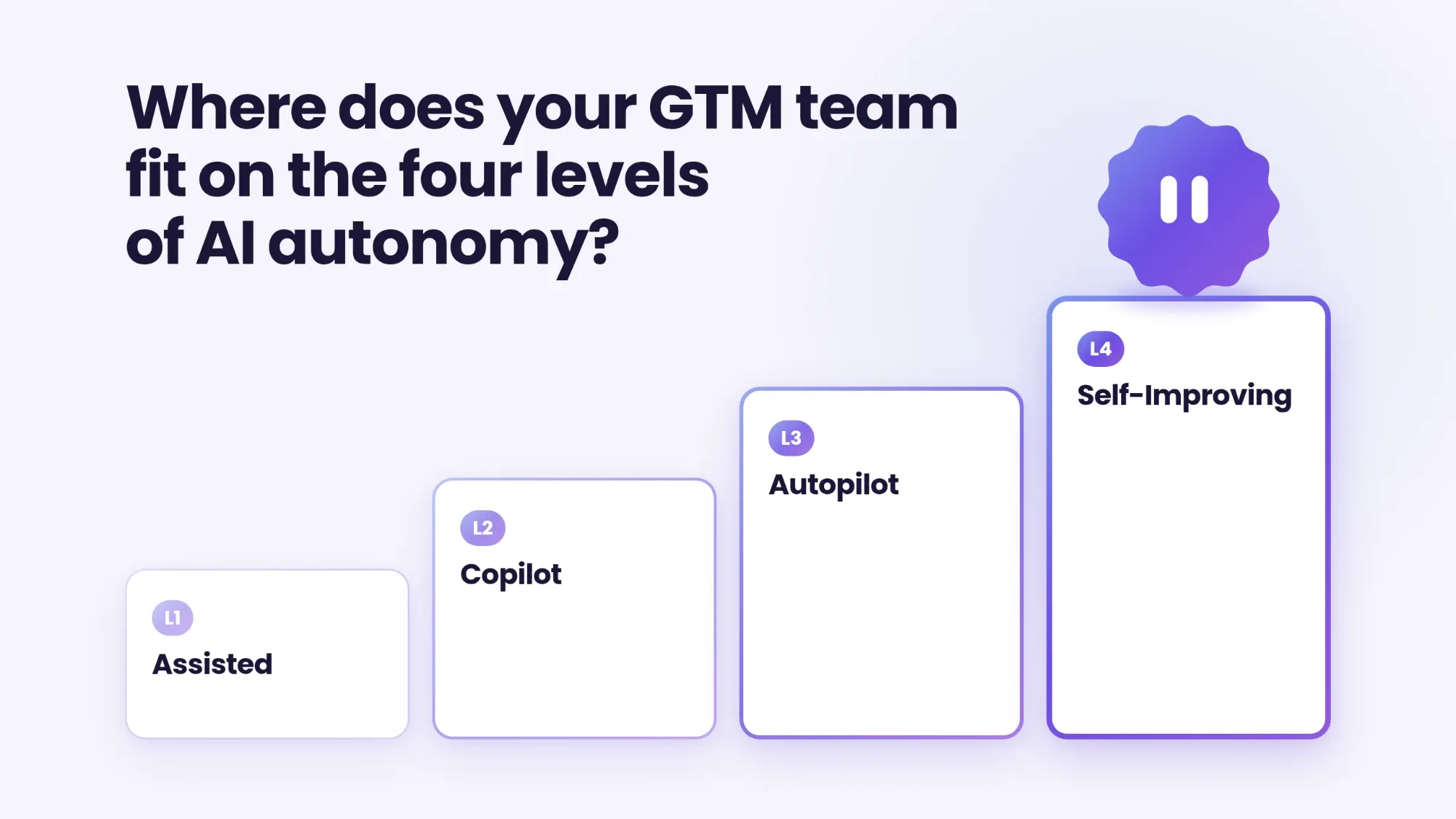
Introducing the Four Levels of AI Autonomy
Most GTM AI maturity models count how many tools a team has adopted. Instead, the four levels of AI autonomy measure something more useful to a revenue leader: how much of the work your AI completes on its own. The framework places every AI workflow on a level by asking two questions. Who starts the work? And who checks and fixes the result?
At the first two levels, a rep answers both questions. At the top two, the answers shift to events in your systems and to automated evaluations. That shift decides whether AI makes individual reps faster or lets your whole revenue engine grow without a matching rise in headcount. Here’s what this looks like for a GTM team at all four levels.
Level 1: Assisted
Level 1 will look familiar. A rep opens a chat window and types “pull everything you can find on this company.” The answer is useful but incomplete, so the rep asks follow-up questions, fixes the gaps, and pastes the result into the CRM.
That loop teaches a team what AI handles well and where it stumbles, but RevOps leaders will spot two weaknesses. Output quality tracks each rep’s prompting skill, so results swing widely across the team. And when reps juggle disconnected tools and re-explain context in every session, nobody records which approaches actually work.
Level 2: Copilot
At L2, the team documents how it sells and hands that playbook to the system. Qualification rules, research steps, and messaging guidelines become custom agents, multi-step playbooks, or reusable templates. A rep asks for “a brief for tomorrow’s call with North East Bank,” and the system pulls the account history from the CRM, reads the notes from the last call, checks open opportunities, and writes the brief.
The payoff shows up quickly. Your strongest rep’s method now runs for everyone, and new hires produce good work sooner because the playbook does the heavy lifting.
Speed brings a new challenge, though. When a brief or an email takes seconds to produce, reps and managers spend their days checking drafts, and review becomes the constraint. Under that pressure, generic messaging to prospects slips through, and reply rates can fall as prospects learn to ignore them.
Where Individual Gains Stop
That review bottleneck marks the ceiling on the first two levels of AI autonomy. L1 and L2 make each person faster, but a person still kicks off every task and signs off on every result. Capacity still rises and falls with headcount, so a bigger pipeline target next year still means a bigger hiring plan.
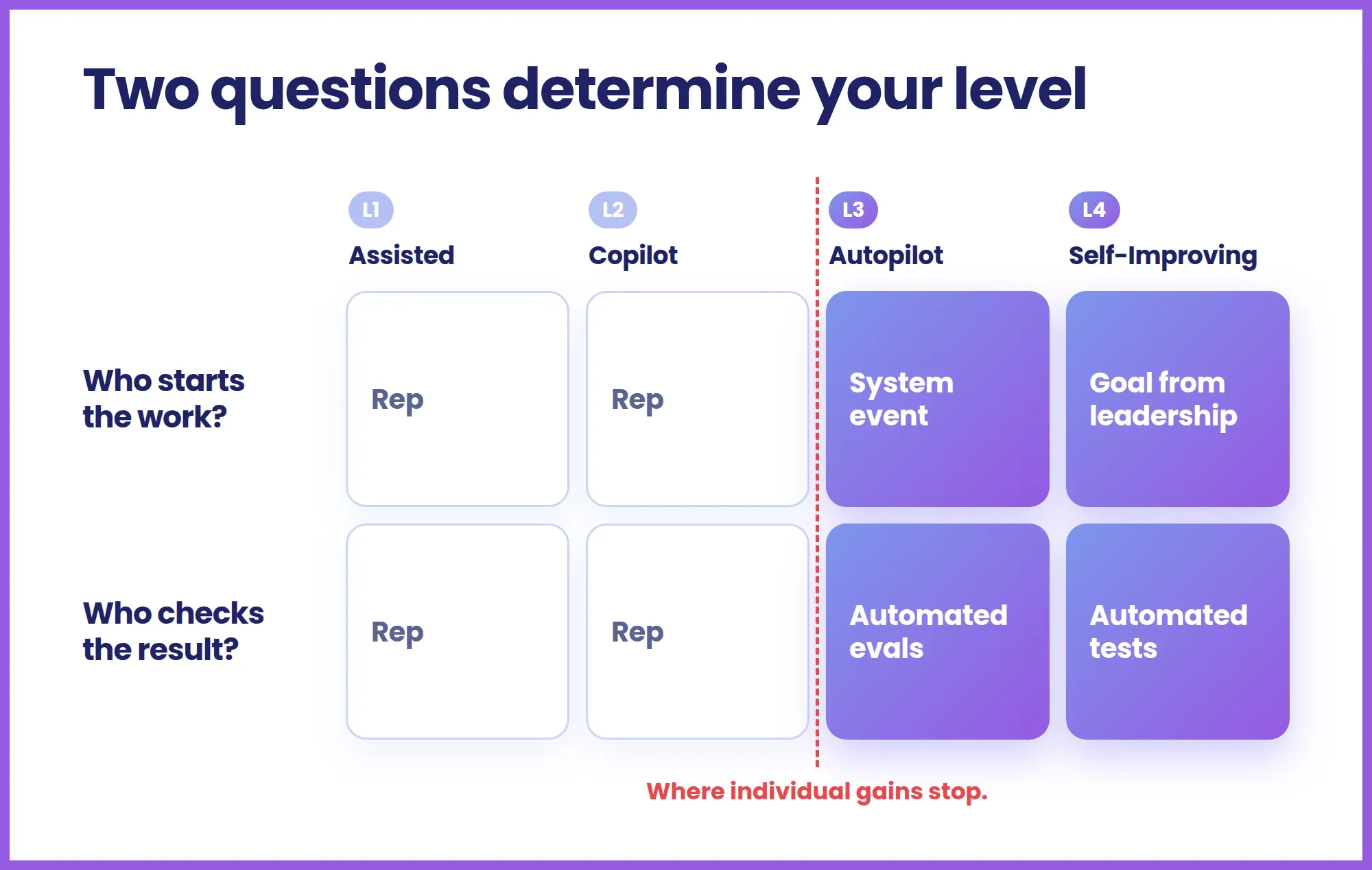
At L1 and L2 a rep starts and checks the work. At L3 and L4, systems take over both jobs.
Breaking through that ceiling means changing the answers to the framework’s two questions. L3 and L4 change both how the work starts and who checks it, and that handoff is what lets pipeline grow faster than the team.
Level 3: Autopilot
At L3, workflows that proved themselves at L2 are now connected to events that automatically trigger agentic action. A form fill creates a lead in HubSpot; an opportunity moves to a new stage; or a prospect accepts a meeting invite, triggering an agent that runs the workflow automatically.
Because no one presses go, no one reviews each output either. Quality control shifts to the system as a whole. The team tests each workflow against agreed standards before launch, dashboards flag any dip in quality afterward, and edge cases route to a person. Your team audits the process that manages a thousand emails instead of having to read each one.
That trade only works with a control layer: approval steps, audit trails, evaluation suites, monitoring, and clear rules for when to hand off to a human. Skip that layer, and you only make mistakes at higher speed.
Level 4: Self-Improving
Once L3 workflows run reliably, the next question is whether they can get better on their own. At L4, leadership hands the system an outcome, such as “book more meetings from outbound,” and provides guardrails and examples of strong work. The system works out the how. It sets up experiments, runs A/B tests on messaging, tightens ICP criteria, and keeps whatever wins. When a new AI model ships, the system trials it on your workflows and adopts it only if quality rises or cost drops.
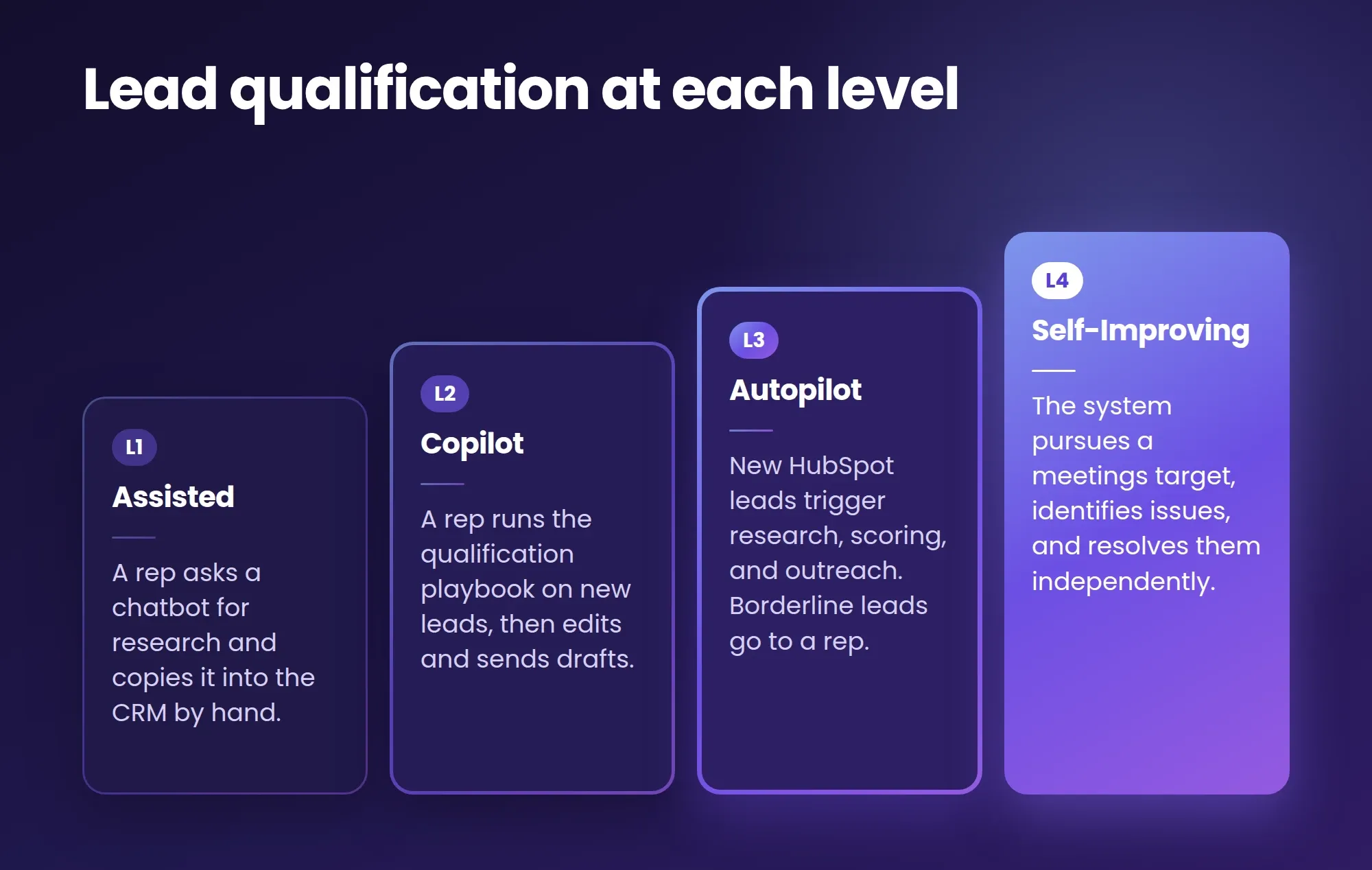
Lead qualification at each level, from a rep copying chatbot research into the CRM to a system that pursues a meetings target.
Only the most advanced companies have L4 workflows today. These workflows are accomplished based on the volume of runs and results that mature L3 workflows produce, so treat it as the destination rather than the first step.
One Workflow, Four Levels: Prospect Research
The differences between the autonomy levels are easiest to see when one task moves through all four. Prospect research makes a good test case, because nearly every GTM team runs it daily. As the task moves up, the rep goes from producing the research, to checking it, to handling exceptions, to setting the goal.
Where Is Your Team Today? A Six-Question Self-Assessment
Seeing the levels side by side raises an obvious question: where do your own workflows sit on the levels of AI autonomy today? Many teams overestimate their level because they count the tools they’ve bought rather than the work those tools finish unassisted. The six questions below give a more accurate read.
- L1: Do reps use AI tools in their daily GTM work?
- L2: Have you written down your qualification, research, or messaging standards in a form an AI system can run?
- L2: Could a new hire produce AI-assisted research as good as your top rep’s in their first week?
- L3: Does any AI workflow start from a CRM or calendar event without a person kicking it off?
- L3: Do you measure AI output with defined evaluations and monitoring rather than manager spot checks?
- L4: Does any workflow adjust its own approach based on results, with tests run before changes go live?
What to Do Next at Each Level
Your assessment result shows where you stand, and it also points to your next move. Each level has one priority that sets up the jump to the level above it, so focus there before spreading effort across every workflow.
- At L1, moving to L2: Move AI work onto one platform connected to your CRM, so every interaction gets logged. Then list the tasks reps repeat most often.
- At L2, moving to L3: Find the workflows that run the same way every time and produce reliable results. Those are your L3 candidates. Write a measurable definition of “good” for each one.
- At L3, ready for L4: Build out evaluation and monitoring, and put more workflows on autopilot. Every run adds to the data from which L4 learns.
As you work through these steps, expect different workflows to sit at different levels of AI autonomy at the same time. The job for GTM and RevOps leaders is to know where each workflow sits and which ones are ready to move up.
Back to that SDR: the fix for her flat pipeline is moving her best workflows to L3, so her day goes to the conversations that close deals.
Want the full framework? Download the Relevance AI whitepaper: The Levels of AI Autonomy.